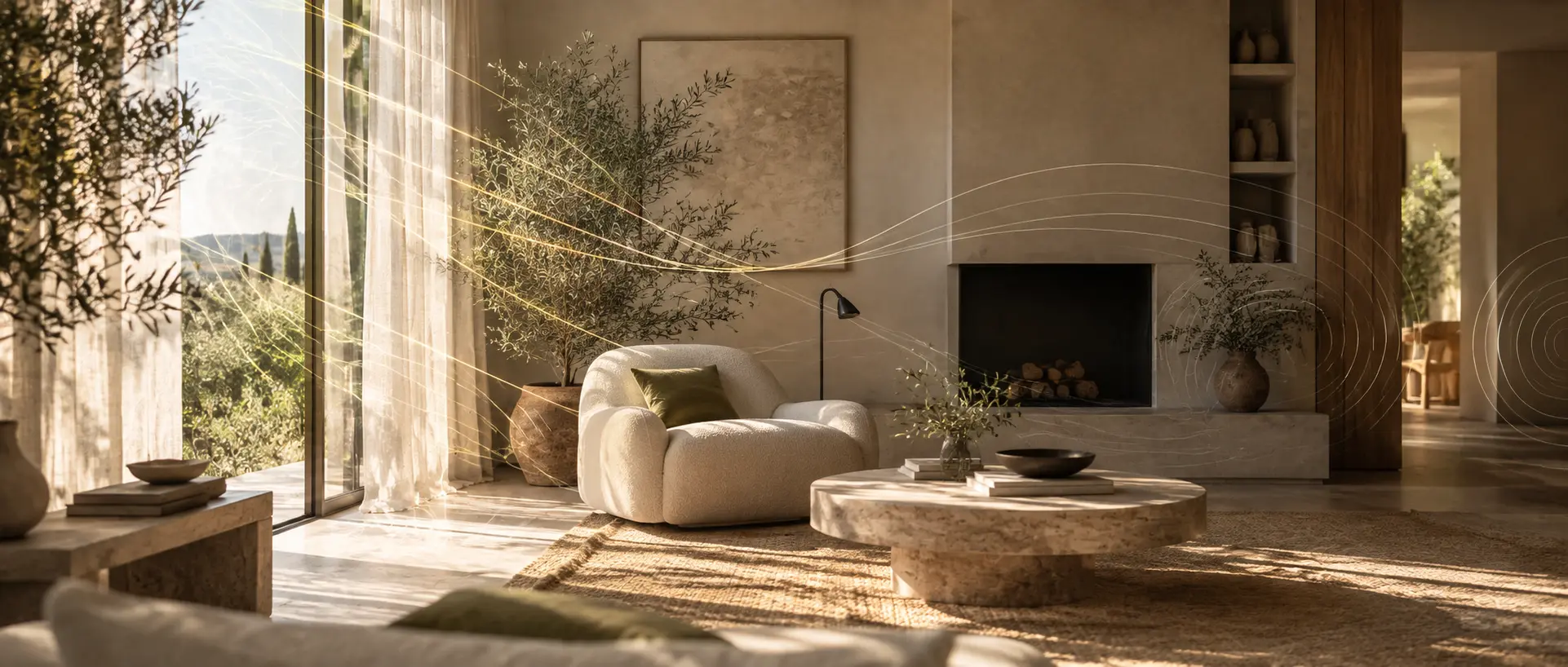
Think about the last time you walked into a room and immediately felt at ease.
Maybe there was nothing particularly remarkable about it. No dramatic architecture, no extraordinary furniture. And yet, something made you want to stay.
The opposite happens too. A room can be beautifully designed and still feel strangely tiring, exposed or difficult to settle into.
These reactions are not based on what we see alone.
As we move through a space, our brain is continuously receiving information from the environment: light, sound, temperature, colour, texture, spatial proportions, visual complexity and our position in relation to what surrounds us.
We consciously notice only part of it.
We experience spaces with more than our eyes
Interior spaces are often described visually: their colours, materials, furniture or style.
But experiencing a room is multisensory.
The softness of the light. A sound coming from another room. The feeling of having a wall behind us. The distance to a window. The amount of movement in our field of vision.
Individually, these details may seem insignificant. Together, they shape the atmosphere we experience.
This may help explain why two spaces that look equally beautiful in a photograph can feel completely different when we are actually inside them.
There is no universal “calming space”
This is an important distinction.
A bright, open environment may feel energising when we need stimulation and uncomfortable when we need rest. A secluded corner may feel reassuring to one person and restrictive to another.
Our response depends not only on the environment itself, but also on context, activity, previous experience and individual needs.
This is one reason neuroarchitecture is so interesting: it encourages us to look beyond aesthetics and explore the relationship between the built environment and human experience.
Instead of asking only:
Does this space look good?
we can also begin to ask:
How does this space make it easier or harder for me to feel the way I need to feel here?
- Is there somewhere for the eyes to rest?
- Does the lighting support what happens in the room?
- Is there too much competing for attention?
- Can I choose between openness and a more protected position?
None of these questions gives us a formula for the perfect interior.
They simply help us pay attention.
And perhaps that is the most interesting place to begin.
At Mind Friendly Spaces, we explore these often unnoticed relationships between people and the environments they inhabit. Understanding how we experience a space can help us design it with greater intention.
Sometimes, we feel a space before we understand why.
Pensez à la dernière fois où vous êtes entré dans une pièce et vous vous y êtes immédiatement senti bien.
Il n’y avait peut-être rien de particulièrement spectaculaire. Pas d’architecture impressionnante, pas de mobilier exceptionnel. Et pourtant, quelque chose vous donnait envie d’y rester.
L’inverse arrive aussi. Un espace peut être très réussi visuellement et malgré tout sembler étrangement fatigant, trop exposé ou difficile à habiter.
Car notre réaction à un lieu ne dépend pas uniquement de ce que nous voyons.
Lorsque nous nous déplaçons dans un espace, notre cerveau reçoit en permanence des informations provenant de l’environnement : la lumière, les sons, la température, les couleurs, les textures, les proportions, la complexité visuelle ou encore notre position par rapport à ce qui nous entoure.
Nous n’en percevons consciemment qu’une partie.
Nous ne faisons pas l’expérience d’un espace uniquement avec les yeux
Nous parlons souvent d’un intérieur en termes visuels : ses couleurs, ses matériaux, son mobilier ou son style.
Pourtant, l’expérience d’un lieu est multisensorielle.
La douceur d’une lumière. Un son provenant de la pièce voisine. La sensation d’avoir un mur derrière soi. La distance qui nous sépare d’une fenêtre. Le mouvement présent dans notre champ de vision.
Pris séparément, ces détails peuvent sembler insignifiants. Ensemble, ils participent à l’atmosphère que nous ressentons.
C’est peut-être aussi ce qui explique pourquoi deux espaces tout aussi beaux en photographie peuvent produire des sensations très différentes une fois que nous nous trouvons réellement à l’intérieur.
Il n’existe pas d’espace « apaisant » universel
Cette nuance est importante.
Un environnement lumineux et ouvert peut être stimulant lorsque nous avons besoin d’énergie, mais devenir inconfortable lorsque nous cherchons à nous reposer. Un coin plus retiré peut rassurer une personne et donner à une autre une impression d’enfermement.
Notre réponse dépend donc de l’environnement, mais aussi du contexte, de l’activité, de nos expériences passées et de nos besoins individuels.
C’est précisément ce qui rend la neuroarchitecture intéressante : elle nous invite à regarder au-delà de l’esthétique et à explorer la relation entre l’environnement bâti et l’expérience humaine.
Au lieu de nous demander uniquement :
Est-ce que cet espace est beau ?
nous pouvons aussi commencer à nous demander :
Est-ce que cet espace m’aide ou, au contraire, m’empêche de ressentir ce dont j’ai besoin ici ?
- Le regard dispose-t-il d’un endroit où se poser ?
- La lumière correspond-elle à l’activité qui se déroule ici ?
- Trop d’éléments sollicitent-ils mon attention en même temps ?
- Puis-je choisir entre l’ouverture et une position plus protégée ?
Aucune de ces questions ne donne une recette pour créer l’intérieur parfait.
Elles nous invitent simplement à observer autrement.
Et c’est peut-être là que commence la réflexion la plus intéressante.
Chez Mind Friendly Spaces, nous explorons ces relations souvent discrètes entre les personnes et les environnements qu’elles habitent. Mieux comprendre notre manière de vivre un espace peut nous aider à le concevoir avec davantage d’intention.
Parfois, nous ressentons un espace avant même de comprendre pourquoi.